On Political Knitting with Ellen Lesperance
«Art & Care» Writing Café will hold a Special Edition with Ellen Lesperance at I Never Read. With Dominique Grisard, she talked about the importance of activism and crafting in her artistic practice.
Your paintings often begin with meticulous translations of knitted garments worn by women activists. What drew you to the idea that a sweater pattern could function as both an archival document and a political image?
I’ve knitted since I was a teenager, and I worked professionally as a knitter, a designer, and an assistant editor for Vogue Knitting magazine in NYC in the late 1990s right after graduate school. I knew a lot about knitting language, and I had been exposed to a lot of traditional and contemporary fashion patterning. First learning about the Greenham Commons Women’s Peace Camp was the catalyst for the paintings. In 2008, in an effort to learn more about the group, I started researching some small press publications that came out of the camp in the mid-1980s, and immediately recognized knitting that I had no prior experience with: political and identity-based symbol use, poetic text, and camp-based imagery. It inspired me to try to find as many examples of these «argumentative» garments as I could from archives spread across the UK, and then to pattern them in the paintings, as they no longer existed, and the paintings then serve as a type of re-generative force.
The Greenham Common Women’s Peace Camps appear again and again in your work. How did you first encounter this protest movement, and what was it about the women’s creative resistance that resonated so strongly with you?
In 2005, I was at a separatist commune in New Mexico briefly while I was pregnant with my first child. A woman who lived there wanted to henna my pregnant belly and I sat with her in her woman-built structure for an afternoon. She was an ex-Greenham camper and she was the one who told me the history of the camp. I was inspired by the political resolve of the campers who both organized against nukes and their direct threat upon human survival, but also organized to set their own revolutionary protest terms: nonhierarchical, anti-masculinist, intersectional. They also quickly identified creative art-making as, ideologically, a counter-war stance; it is free, generative, thoughtful, often beauty- or care-based.
It reminds me of the gesture of care implicit in each hand-knit garment, and the durational aspect of any type of change.
You have sometimes recreated the sweaters you paint, knitting them from the patterns you extract. How does the act of making—of stitching, counting, repeating—shape your understanding of feminist histories of care, labor, and protest?
I consider the paintings as prompts for the action of the remaking of the garments, although this remaking is sort of conceptual for a lot of the works as they get so visually complicated that they would be hard to actually follow in many cases. Sometimes following them is pretty straightforward, however, and I like to have at least one going at all times so that with each exhibition, I can at least show one that has made this ultimate last step in the process: the peace artifact coming back into the world for us. All of the sweaters are hand-knit by me, so they, of course, each take even longer than the paintings to make. The labor of making them is interesting to me, because it reminds me of the gesture of care implicit in each hand-knit garment, and the durational aspect of any type of change.
Much of your work honors forms of activism that were collaborative, creative, and often overlooked. What do you hope contemporary viewers take away from these textile‑based legacies of courage and collective action?
Greenham Common is a touchstone for me in terms of its marriage of grassroots activism and creative making. And it lays out the ethos of creative making as anti-violent. Agency in the face of a more and more militarized, economically stratified, ideologically totalitarian world feels harder and harder to come by. Textile-based legacies contain the traces of human will, the human hand, a person’s personal choices.
Writing is also a craft. How has writing played a role in your studio practice?
Alongside the paintings and textiles, the deep research I’ve done with the Greenham Commons archives presented me with a lot more information than images of camper sweaters, I have read much: many first-person accounts, legal defense papers, letters, poetry, etc. Concurrent to the studio making, I wrote a novel, Peace Camps, self-published in 2017. One thing that I am very interested in is the complex legacies of feminism, and the political and generational shifts that present conflicts within ideological movements – and trying to write through that. I am publishing a new book, a type of memoir/speculative biography – 100 Men or More – in the fall with a Portland, Oregon-based press called Some People’s Press – a press that primary works with incarcerated writers to develop their memoirs. I have been researching the feminist painter Sylvia Sleigh for the past decade, visiting her archive at the Getty Library in Los Angeles, and sort of secretly making art gestures towards her practice. The book asks: how do we shift the structures that we use to access, appreciate, and define historic art practices? If I resonate with a matrilineal peer like Sylvia Sleigh, it is interesting for me to think of that resonance in the spirit of Italian feminist Carla Lonzi’s 1970s’s concept of «autocoscienza», an exercise towards consciousness-raising. To examine both myself and Sleigh is to recuperate information about both of us; it is a creative and critical exercise with one additional generation of lived feminist and intersectional life between us.
Save the Date!
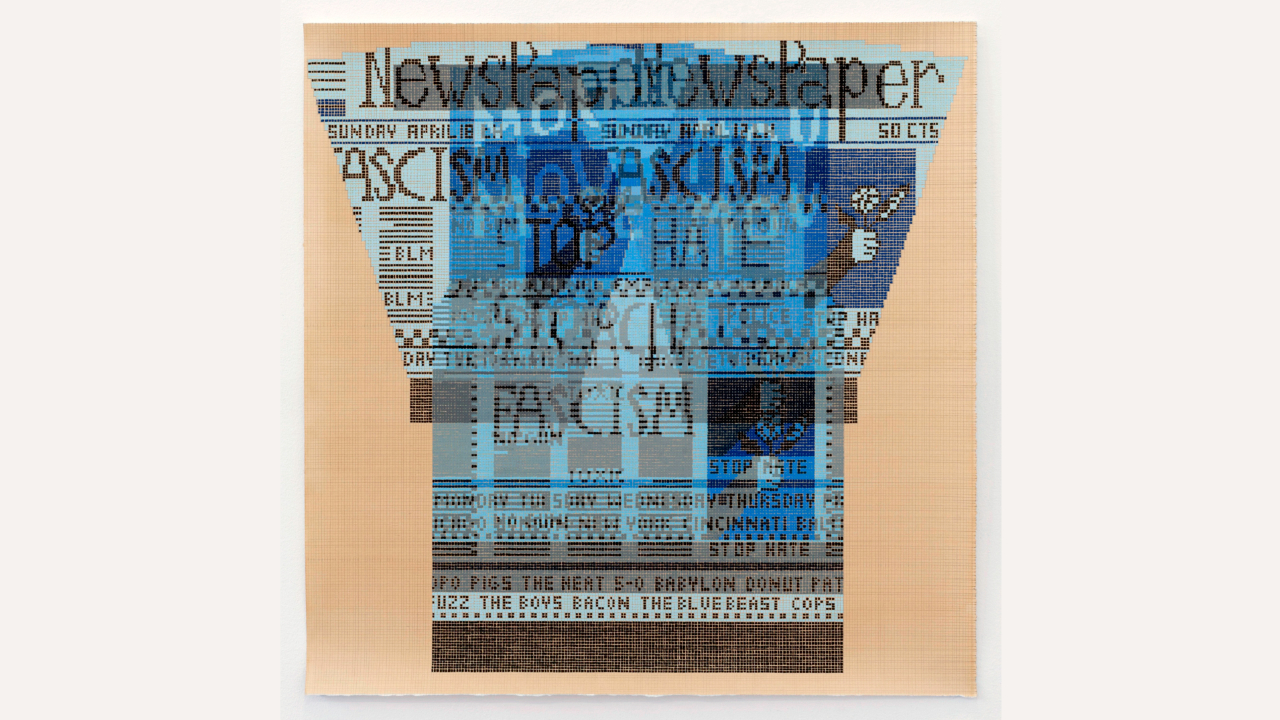
Featured Image: Ellen Lesperance: Stop Hate, 2019. Gouache and graphite on tea-stained paper, 75 x 75 cm. © Ellen Lesperance. Courtesy the artist and Hollybush Gardens, London.